Regulators are scrambling. Watchdogs are sounding alarms. Governments are drafting emergency legislation.
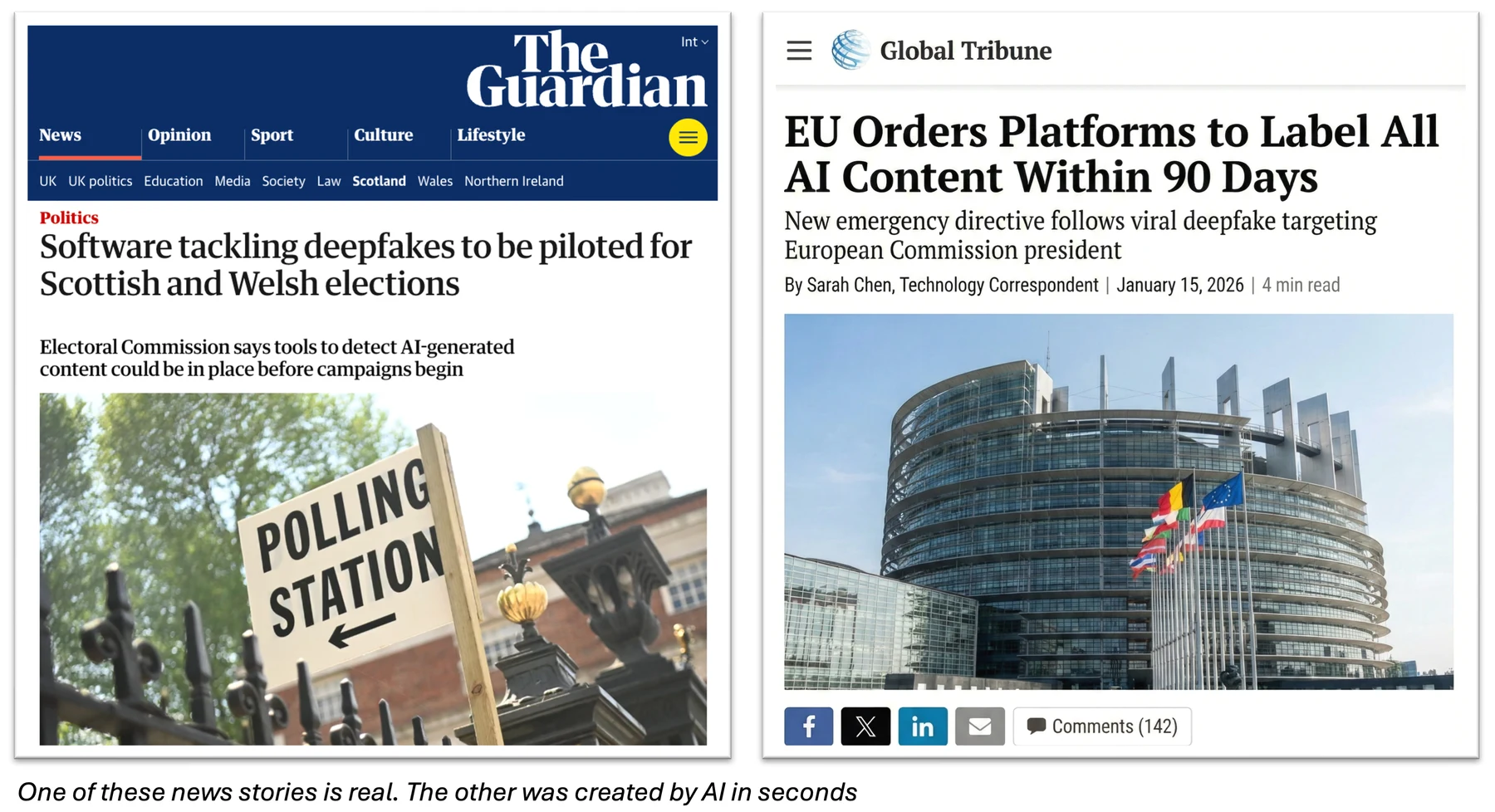
If you assumed the ‘Global Tribune’ headline on the right was real, you proved why those regulators are scrambling. It is a complete fabrication. I created it in seconds. Deepfake concerns have simmered for years, but now that the line between real and synthetic has vanished, the panic has gone mainstream.
Everyone agrees we are facing an unprecedented crisis. But they are wrong.
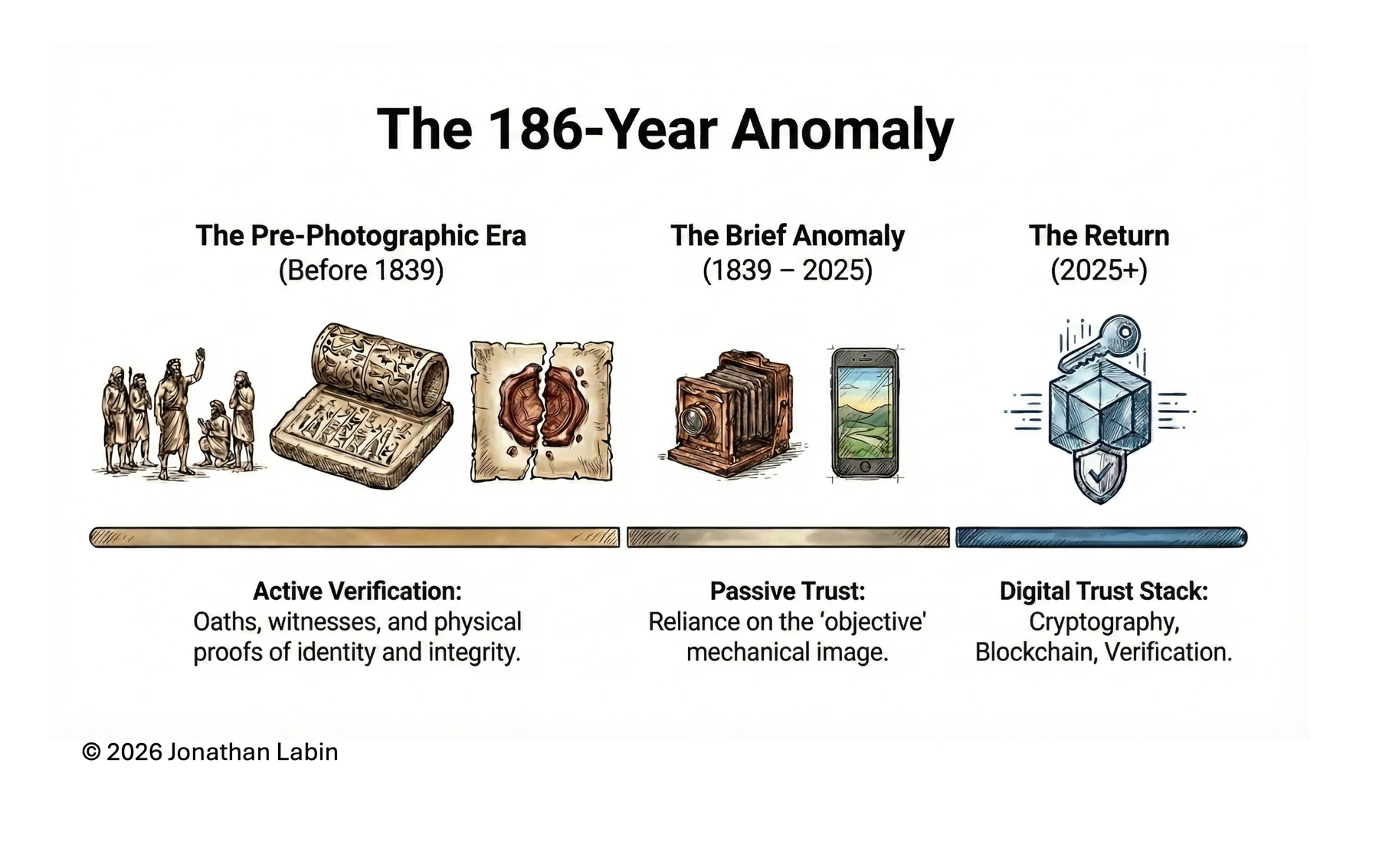
The idea that photos and videos reliably capture what happened is the anomaly in human history, not fake media. For thousands of years, humans built elaborate verification systems precisely because they could not trust what they saw. The 186-year era of photographic trust, stretching from 1839 to now, is the exception. Deepfakes are not ending civilization. They are the cure for the false confidence that the photographic era bred into us, the lazy assumption that seeing is believing.
This is not a particularly new idea. Kevin Kelly said it in 1985: “You can't trust the medium; you can only trust the source.” But given the current panic, some context seems in order.
The Pre-Photographic Norm
Before photography, no culture had technology that could mechanically capture reality. Every form of media, whether the written word, paintings, or sculptures, was made by human hands. And humans lie. So every civilization operated on a simple principle: never trust the medium.
What did they trust instead? Sources, institutions, and redundancy. Before writing even existed, oral societies relied on sworn oaths, community witness, and reputation. Truth was verified socially. Once records emerged, the systems grew more sophisticated but the logic stayed the same. Mesopotamian cylinder seals from 3500 BCE were pressed into wet clay to leave distinctive impressions that were hard to forge. Medieval Europeans layered additional safeguards: wax seals that revealed tampering when broken, notarial witnesses who served as trusted third parties, chains of custody tracking who handled a document and when.
This was not naivety. It was humility, a deep awareness that evidence could be fabricated. For millennia, verification depended on who sealed it, who witnessed it, and who vouched for it. The parchment was just parchment.
The 186-Year Exception
Photography changed everything. The camera's claim was radical: mechanical objectivity. Light itself etched the image onto the plate. A photograph was not an interpretation. It was a physical trace of something that actually existed. For the first time in human history, a medium seemed to guarantee its own truthfulness.
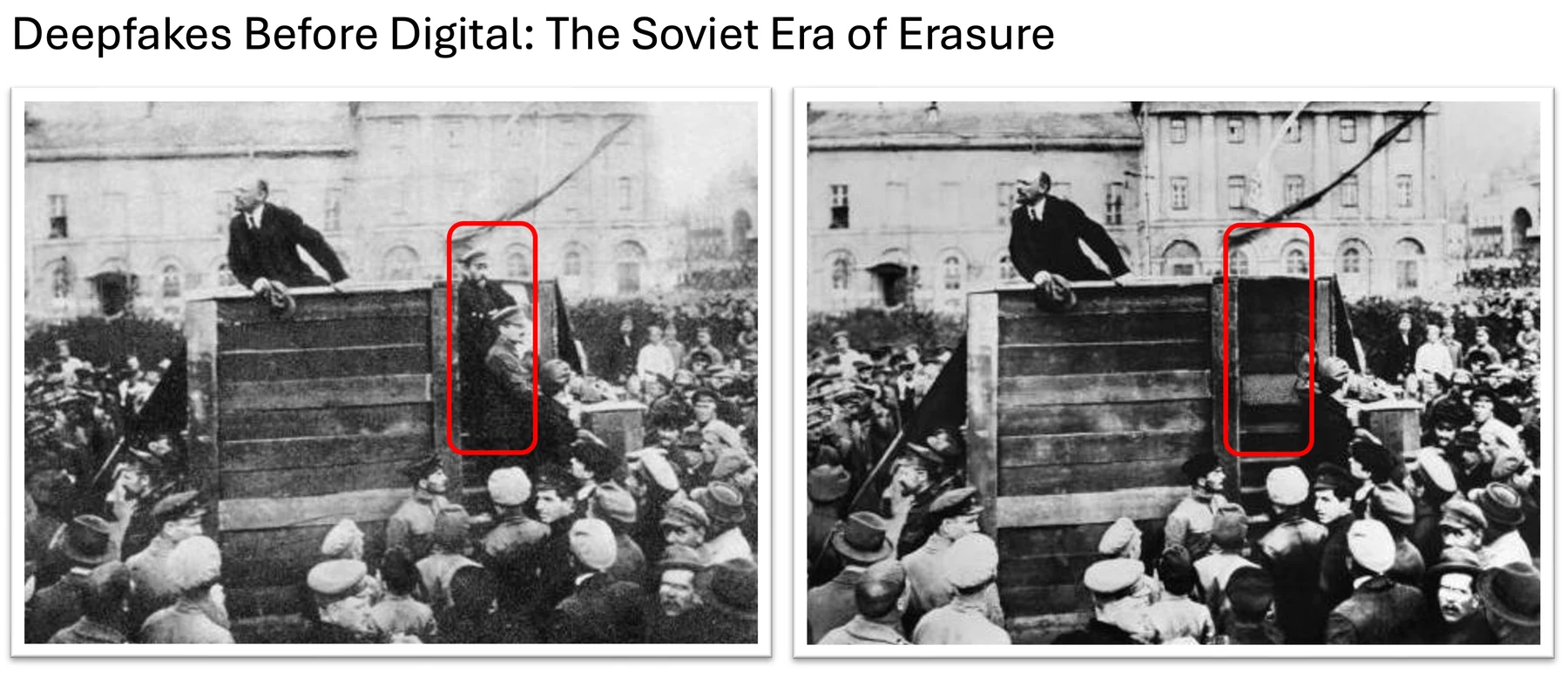
But this myth was fragile from the start. Scammers discovered that double exposures could superimpose ghostly figures onto portraits. One, William Mumler, built a thriving business in 1860s Boston, selling grieving families fabricated photos of their dead relatives, including a famous image of Mary Todd Lincoln with the “ghost” of President Lincoln hovering behind her. The Soviets later industrialized the practice, systematically erasing purged officials like Trotsky from historical photographs.
Yet the broader cultural belief in photographic truth persisted. When video emerged, it became the ultimate proof. If it was on tape, it was real. We built legal systems, journalism, and social trust on that assumption. Then we forgot it was an assumption at all.
Deepfakes are now forcing us to remember.
The Return
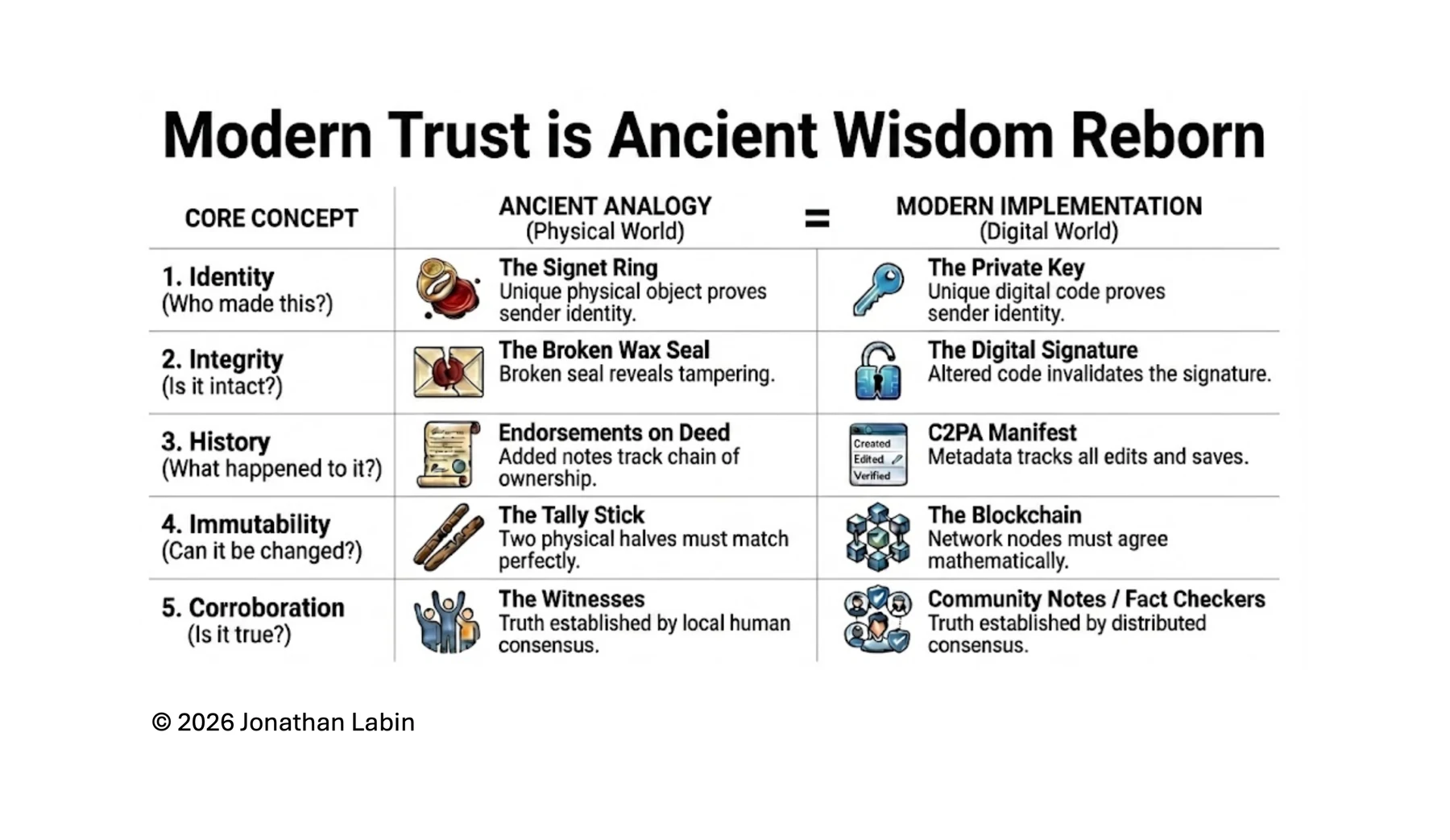
The solutions emerging today are not new ideas. They are ancient verification principles translated into digital form.
C2PA, a coalition of leading technology and media companies, has developed cryptographic “Content Credentials” that document a file's origin and edit history. If content is modified after signing, the credentials reveal it. Instagram head Adam Mosseri made a similar point in his widely discussed memo from late 2025: “It will be more practical to fingerprint real media than fake media.” Work with device manufacturers to cryptographically sign images at capture. Create a verifiable chain of custody. Do not chase fakes. Certify what is real. This is the digital equivalent of a wax seal.
Open-source networks like Bellingcat and professional fact-checkers act as expert witnesses, verifying content through forensics and investigation. Meanwhile, systems like Community Notes function as a distributed public jury. The pattern is unmistakable: verify the source, build networks of trust, demand corroboration. Everything except trusting the medium itself.
What This Means
None of this means deepfakes are harmless. Today, they enable fraud, erode trust, and give bad actors a “liar's dividend,” the ability to dismiss genuine footage as fake. And unlike pre-photographic forgery, technology makes deception scalable. Anyone with a laptop can now do what once required a state propaganda ministry.
Detection will not save us. It is an arms race with no finish line; every improvement in detection is met with better generation. The sustainable path forward is the old one: verify the source, not the content.
As verification infrastructure matures, the harms fade. Fraud becomes harder when provenance is traceable. Trust rebuilds around authenticated sources. And once those sources are clearly marked, claiming “that's fake” without evidence loses its power.
This transition will take years, and it will be painful. Real harm will be done along the way. But my two-year-old daughter will grow up in a world where skepticism toward media is the default, where “who made this?” is always the first question. That sounds alarming to those of us raised in the photographic era. Historically speaking, it is perfectly normal.
Deepfakes are not breaking our relationship with truth. They are curing us of a dangerous illusion, the belief that any medium can be trusted on its own. We are returning to the way humans have always navigated an uncertain world: by trusting people, not pictures.
This article was originally published on LinkedIn.